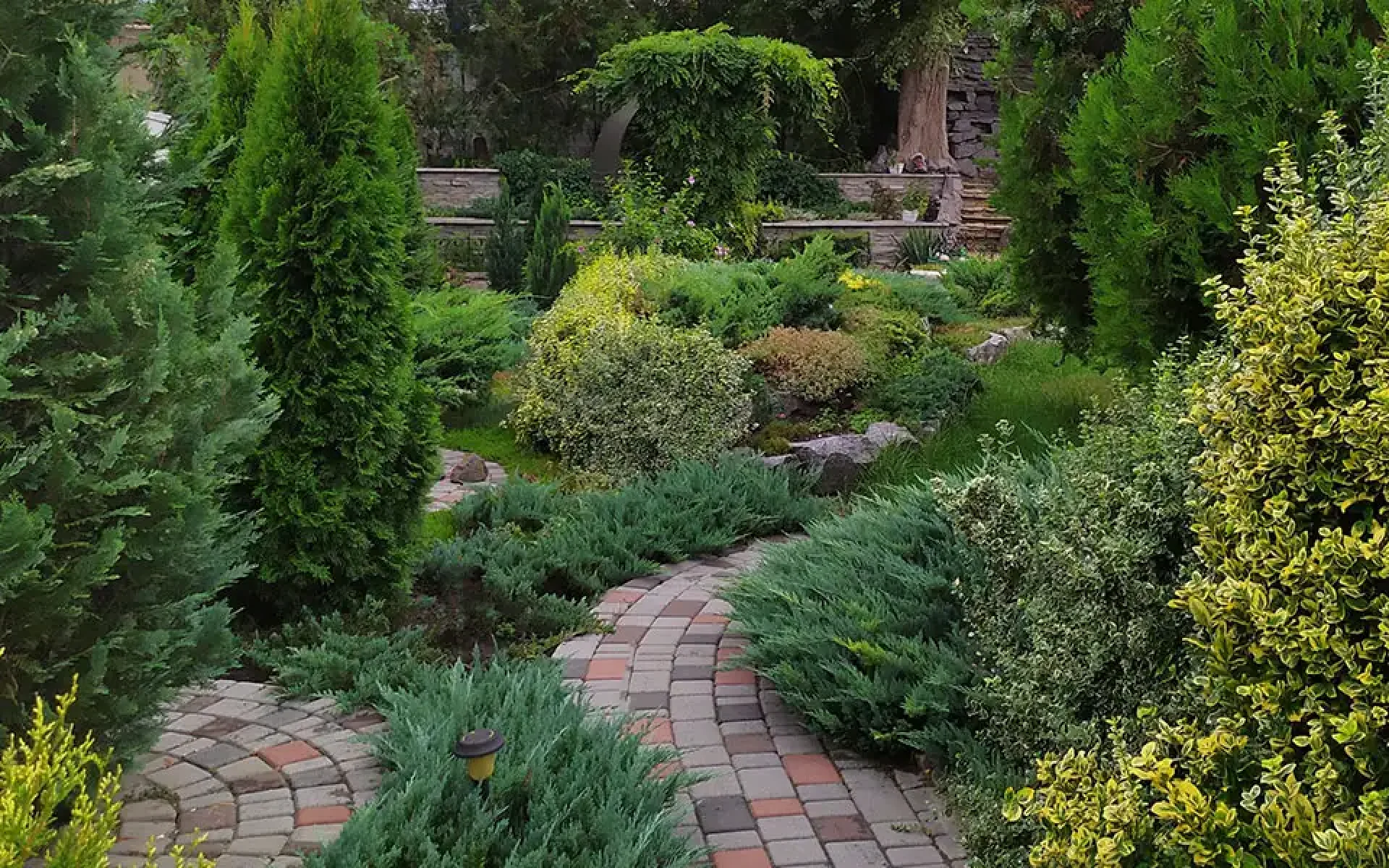
The landscape in February tells the truth.
When the perennials are cut back, the flowering trees are bare, and the lawn is not exactly giving its best performance, the plants carrying the whole scene are usually the evergreens. That’s why conifers matter so much. They hold color through winter, keep strong shapes in the garden, and do the practical work of screening, privacy, wind buffering, and year-round structure. Arborvitae, blue spruce, and Norway spruce are all widely valued in the landscape for exactly those reasons.
At Bountiful Acres, we think that role deserves more attention.
We grow these and all of our ball-and-burlap trees and shrubs on our 100-acre Bucks County farm, and that gives us the chance to focus on curated varieties that bring real staying power to a landscape. This is not a collection built around one look or one purpose. It includes dependable evergreens for privacy and screening, graceful forms that soften a bed or entry, and unusual specimens that instantly make a garden feel more thoughtful and more complete.
That’s part of the beauty of conifers. They aren’t just “green background plants.” They are some of the most useful, expressive, and hard-working plants in the landscape.
A good conifer can anchor a front foundation planting. It can make a patio feel more sheltered. It can screen a road, frame a view, or give a border the kind of depth that keeps it from looking flat in winter. Even more, it can make every flowering tree, hydrangea, and perennial around it look better by giving all that seasonal color something solid to play against.
And that’s what a well-balanced landscape really needs. Not just spring excitement or summer fullness, but year-round bones.
Not All Evergreens Do the Same Job
One of the biggest misconceptions about conifers is that they all do roughly the same thing. They do not.
Some are upright and architectural. Some are soft and layered. There are those that bring deep green calm, while others bring blue, gold, or gray-green tones that completely change the palette of a planting. Some are broad and sheltering. And some are narrow and vertical. Others are quietly dependable, and some are gloriously odd in the best way. For example, see what these are known for:
- Deodar cedar: pendulous, graceful branching
- Hinoki cypress: softly pyramidal form and flattened sprays
- Hollywood juniper: sculptural branching
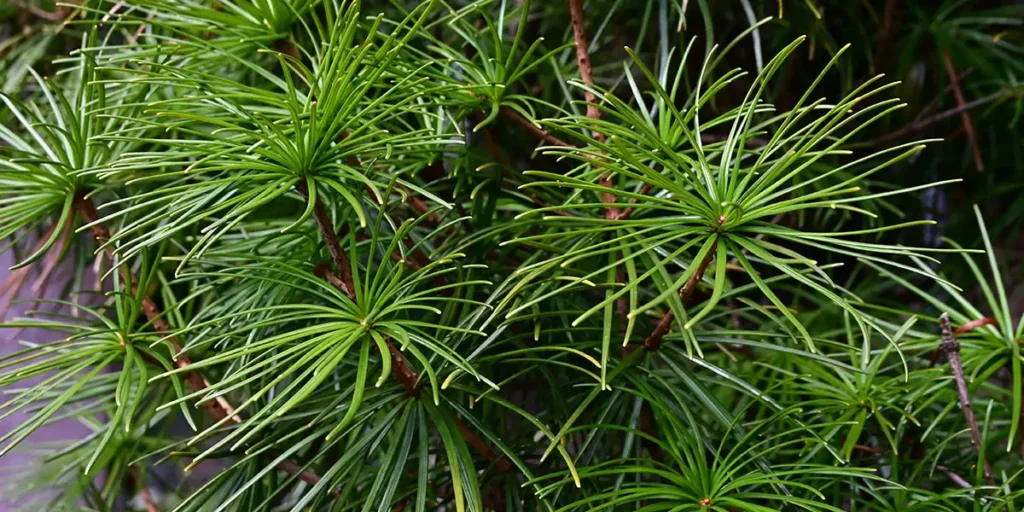
- Japanese umbrella pine (shown): distinctive whorled needles
- Oriental spruce: dense, narrow-pyramidal habit
That range is exactly why conifers are so valuable in design. You don’t plant them all for the same reason. You choose them the way you choose furniture for a room. One piece provides structure. Another softens an edge. Another becomes the thing everyone notices first.
A row of screening evergreens handles a practical need. A single unusual specimen near a front walk changes the character of the entire entry. And a layered grouping of different conifers can add so much texture and contrast that the bed still feels alive even on a gray January day.
A Quick Tour of Our Conifer Collection
Our evergreen conifer collection includes arborvitae, Eastern hemlock, golden deodar cedar, hinoki cypress, Hollywood juniper, Japanese cedar, Japanese umbrella pine, nootka cypress, Colorado blue spruce, Norway spruce, oriental spruce, weeping white spruce, Japanese black pine, Japanese white pine, Korean pine, and Swiss stone pine. Together, they offer a remarkable mix of color, texture, habit, and landscape function.
For Privacy, Screening, and Strong Evergreen Presence
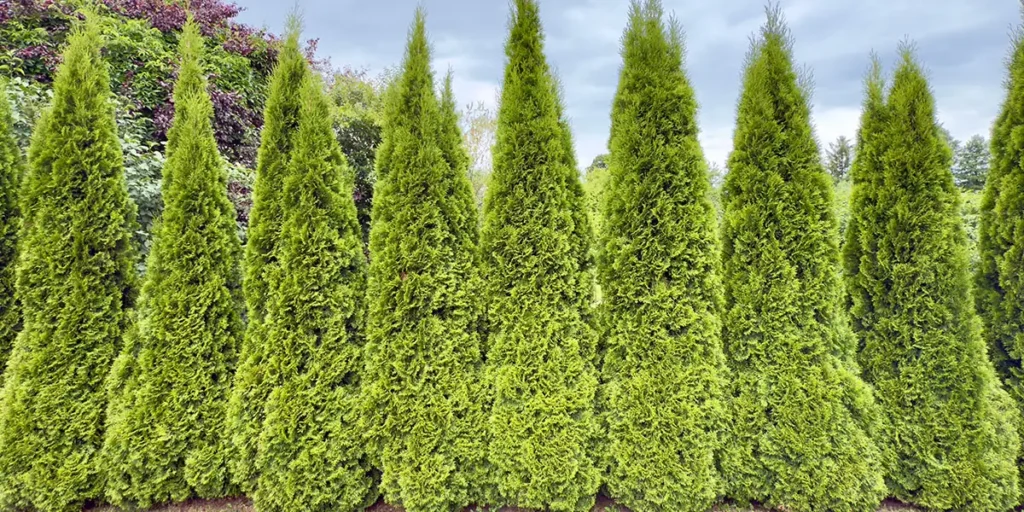
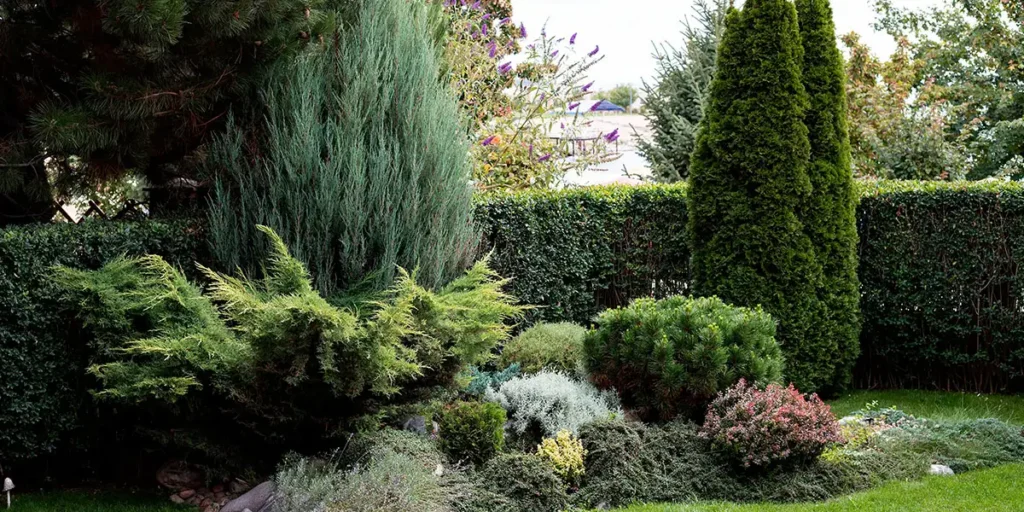
Arborvitae, Thuja spp. (shown), remains one of the most dependable choices. It’s low-maintenance and useful in a range of landscape situations.
Eastern hemlock, Tsuga canadensis, brings native evergreen character to the palette.
Japanese cedar, Cryptomeria japonica, adds substantial green mass along with attractive reddish-brown exfoliating bark.
Norway spruce, Picea abies, is vigorous and especially useful where larger-scale screening or wind buffering is needed.
Nootka cypress, Callitropsis nootkatensis, offers another screening option, but with a slower, more refined presence.
For Graceful Forms and Standout Texture
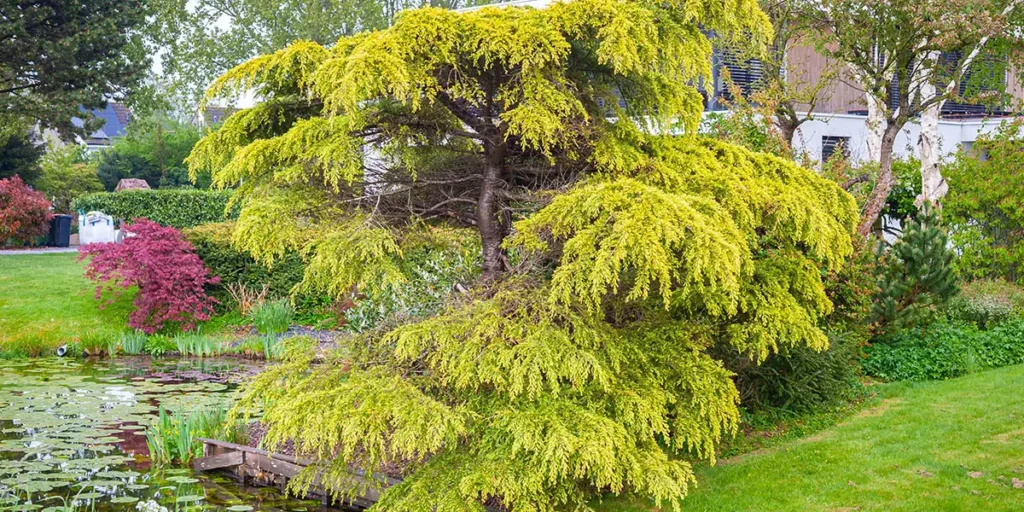
Golden deodar cedar (shown), a golden-toned selection of Cedrus deodara, brings sweeping branch tips and a softer silhouette than many people expect from an evergreen.
Hinoki cypress, Chamaecyparis obtusa, is prized for its rich texture, flattened sprays, and handsome form.
Hollywood juniper, Juniperus chinensis ‘Kaizuka’, looks almost hand-sculpted, with twisting upright growth that gives it immediate personality.
Japanese umbrella pine, Sciadopitys verticillata (shown), is one of the most distinctive conifers in horticulture, with whorled needles that inspired its common name.
Weeping white spruce, commonly grown as Picea glauca ‘Pendula’, adds a narrow cascading shape that can make even a small planting feel more dynamic.
For Color and Specimen Interest
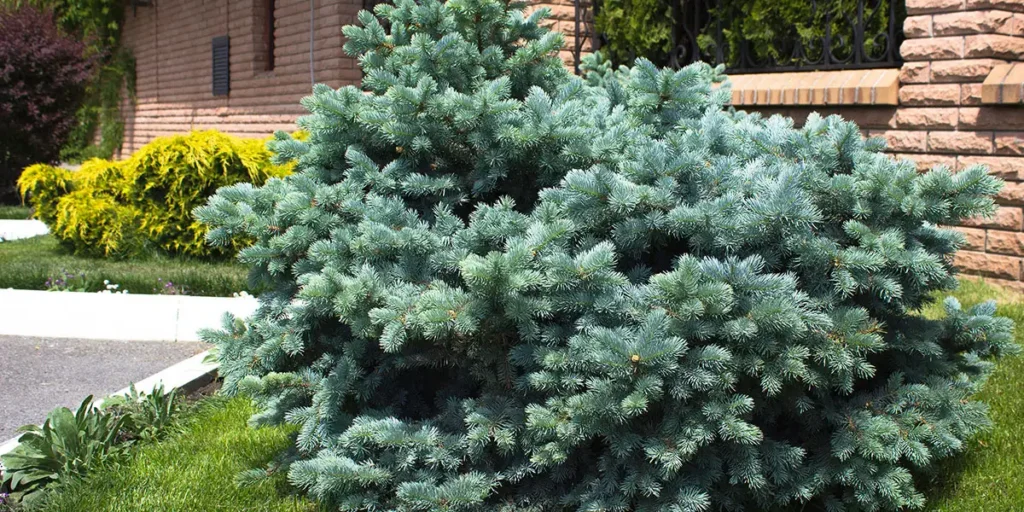
Colorado blue spruce (shown), Picea pungens, brings that unmistakable silvery-blue note that reads beautifully against brick, stone, and broadleaf plantings.
Oriental spruce, Picea orientalis, is darker, denser, and more refined in look.
Japanese black pine, Pinus thunbergii, has bold needles, strong character, and an irregular maturity that feels especially striking.
Japanese white pine, Pinus parviflora, becomes picturesque with age and is long admired for its elegant branching.
Korean pine, Pinus koraiensis, has a full, handsome habit and large cones with edible seeds.
Swiss stone pine, Pinus cembra, is valued for its dense, orderly outline and lasting fullness.
And that’s the point of a curated collection. It gives you options, not just inventory. Instead of settling for “an evergreen,” you can choose the evergreen that actually fits the job, the space, and the style of your property.
What Evergreen Conifers Really Add to a Landscape
They add calm.
That may sound funny when we’re talking about plants as dramatic as golden deodar cedar or Hollywood juniper, but it’s true. Evergreens steady a landscape. They keep it from feeling empty in winter and chaotic in summer. They give the eye a resting place. And they connect one season to the next.
They also add contrast, which is one of the great secrets of good landscape design. Fine needles next to broad hydrangea leaves. Dense conical forms behind airy ornamental grasses. Deep green foliage behind bright spring flowers. Blue spruce beside gold foliage. A weeping form near a strong upright one. Those combinations are what make plantings feel layered and intentional rather than random.
And of course, conifers solve practical problems beautifully. If a property needs privacy, arborvitae, Norway spruce, Japanese cedar, or nootka cypress may be part of the answer. If a bed needs winter presence near an entry, hinoki cypress, Swiss stone pine, or weeping white spruce may be a better fit. Maybe the garden needs a memorable specimen, Hollywood juniper, Japanese umbrella pine, Japanese black pine, or Japanese white pine can shift the whole tone of the space. Those uses line up closely with the growth habits and landscape roles described for these plants by horticultural references.
That flexibility is a big reason one conifer is almost never enough.
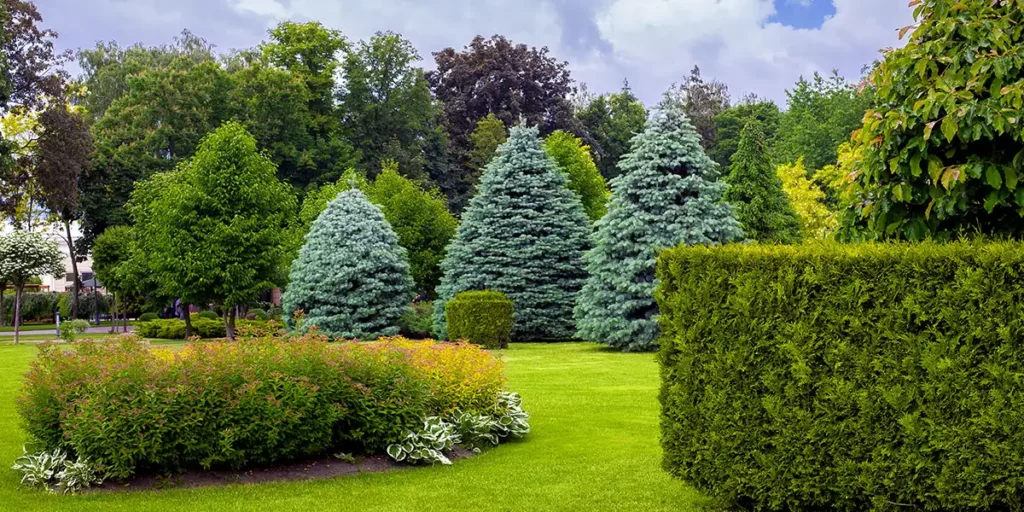
A landscape often needs a screen in one area, a specimen near the front walk, and lower evergreen mass to keep foundation beds from disappearing in winter. It may also need a change in texture from one garden room to the next. Conifers help with all of that. A property might use arborvitae for privacy along one edge, a blue spruce or oriental spruce for contrast in an open lawn, and a hinoki cypress or Japanese white pine where closer-up beauty matters most.
That kind of layering is what makes a landscape feel finished. Not stiff. Not crowded. Finished.
Why These Plants are Worth Making Room For
Flowering plants usually win the first impression. Conifers usually win the long game.
They are there in January, when everything else has stepped back. In March, they’re there when you are desperate for color. They are there in July, when the garden can start to feel visually busy and needs structure. And they are there in November, when the rest of the landscape is starting to fade. Blue spruce keeps its cool color. Arborvitae keeps its wall of green. Pines keep their character. Hinoki cypress keeps its texture. Japanese umbrella pine keeps being unlike anything else nearby.
That’s lasting value.
At Bountiful Acres, our evergreen conifers are curated with that in mind. We want these plants to do more than fill a space. We want them to hold a landscape together, give it depth in every season, and offer the mix of dependability and beauty that makes people glad they planted them years later. Grown on our 100-acre Bucks County farm along with all of our ball-and-burlap trees and shrubs, these evergreens are selected to bring year-round color, texture, structure, and standout garden interest to the places people care about most.
A balanced landscape needs flowers, yes. It needs shade, privacy, and seasonal change, too. But it also needs plants that keep showing up. That’s what evergreen conifers do, and they do it brilliantly.